Showing posts with label industry. Show all posts

Wednesday, April 25, 2012

When to hold, part 4: New record edition


Waiting for all the rorquals that some asshole dumped on the market in akora at 2.64 to sell has finally paid off. The minerals for the lovely item you see above cost me 1.7, for a single-hull profit of 1.55 billion, a quarter billion more than my previous record.

In the meantime thanatos have also caught up to the market, and I sold one for 100% profit. The only hulls which are still selling low are chimera (100m above mineral price), phoenix and naglfar (both below mineral price).

Something I'm noticing is that most ships seem to have a psychological break point for how high people are willing to go even in the brave new market. For dreads this seems to be about 3 billion, and carriers around 1.5. Ships have been sold above these values, but only a few (three, to be precise), and when the only ships available are above that they tend to sit for days without selling.

I'm not sure if this will hold true for the rorqual. My suspicion that it could stabilize above 3 billion without another mineral spike is very low, but unlike carriers and dreads it's an infrastructure investment rather than a disposable combat ship, so people may be less reluctant to pay very obscene prices for them. And ooh, lookit all them suckers people suddenly getting into 0.0 mining....

Wednesday, April 18, 2012

When to hold, part 3: Mocking laughter edition

Three days ago I made this post, in which I mentioned that I had sold a moros for 2.96 billion, when two days earlier they had been selling for 2.2

When that hull sold, there were zero left on the market. The next day, there were 5 on the market.

When there are zero of something on the market, the first person to put one up gets to pick whatever number they like. There are two schools of thought about what to do in this situation:  One is to pick an obscene highball figure, just in case somebody goes for it. Something like four billion, in this case. The other is to pick a number that is within the realm of sanity, hoping to sell before more units come on the market at a lower price. Say, 3 billion. Maybe 3.2 or 3.5 if you really want to push it.

The five individuals who put up moros hulls subscribed to a third school, a school of non-thought. They actually lowballed, picking a number which was only 400 million (18%) above mineral price.

While their hulls were still on the market I finished a second moros hull, having held the previous one nearly 10 days before it sold. I put it up for 3 billion.

Today?


By way of illustration, here is the market graph from the last 10 days:


Counting two sold to buy orders, seven hulls were sold between my own two sales. The drooling morons who sold those hulls pissed away around four billion isk between them, just because they couldn't be bothered to put any thought into it.

In conclusion, it is your duty as a person who likes money to highball in a seller's market.


...also, in the meantime I've sold two carriers for 1.44 each, a profit of about 90%. Oh, and I suppose the second moros sale ups my largest profit on a hull to 1.3.

Tuesday, April 17, 2012

Building capital ships like a boss, part 10: Selling your ships

Seeing this post first? Go to part 1.

Index:


1. Introduction
2. Ship blueprints
3. Component blueprints
4. Researching your blueprints
5. Moving capital blueprints safely
6. Spreadsheets
7. Location, location, location
8. Moving minerals
9. Actually building stuff, finally
10. Selling your ships (you are here)

Another easy one. Put them on the market and wait for somebody to buy them. There are a few things I've noticed, though:

  • Capital ship prices vary quite a bit over a matter of weeks. If you think the market price for a hull is low, consider hanging on to it for a while. Odds are you're right.
  • Sometimes a bunch of one hull will get dumped on the market and the price will fall to barely above mineral price. When this happens, just wait it out.
  • Sometimes it doesn't pay to be the lowest sell order on the market. If the lowest sell order is 100m below the next lowest, odds are you're better off undercutting the second lowest rather than the lowest.
  • When mineral prices go up, not everybody who sells capitals has the presence of mind to reset their sell orders to somewhere above the new mineral price. In this situation I recommend holding and waiting for the market to catch up. This can take weeks, however.


...and that's all I have to say about that. This is the last post in the series.

Building capital ships like a boss, part 9: Actually building stuff, finally

Index:


1. Introduction
2. Ship blueprints
3. Component blueprints
4. Researching your blueprints
5. Moving capital blueprints safely
6. Spreadsheets
7. Location, location, location
8. Moving minerals
9. Actually building stuff, finally (you are here)
10. Selling your ships


This is the easy part. Build the components, then build the hulls. There are a few notes which can be made, though, mostly common sense stuff:
  • Start the components you need the largest numbers of first. If you or the station run short of slots, this will increase efficiency.
  • If you have duplicate component blueprints, you can either build half the components from a run with each blueprint, or use one blueprint for one run and the other for the next run. I recommend the latter: It's easier, and after the first run the efficiency is the same (though there may be corner cases where this isn't true).
  • You'll want to track the status of each of your blueprints. See section 6 for a simple way to do this.
  • You'll want to track which components and hulls from which runs you're working on. I track this on my spreadsheet just using a list of components and hulls in each run and some color coding, like so:


Go to part 10: Selling your ships

Building capital ships like a boss, part 8: Moving minerals

Index:


1. Introduction
2. Ship blueprints
3. Component blueprints
4. Researching your blueprints
5. Moving capital blueprints safely
6. Spreadsheets
7. Location, location, location
8. Moving minerals (you are here)
9. Actually building stuff, finally
10. Selling your ships


So let's say you have your blueprints in your building station. Now you need to get minerals there. There is more than one way to do this.


The simple way:


You have a freighter, a jump freighter, and a cyno alt. You move the minerals to the adjacent highsec system with the freighter, light a cyno with your alt, and jump them in with the jump freighter. This is what I do.

This is almost completely safe, since while in lowsec you're always in jump or dock range of something you can use to escape if a pvp scrub shows up.

It is possible to move up to 3 JF loads of minerals per 10 minute cyno activation, or 108 million units. It takes me about an hour to move minerals for 4 hulls from highsec to low, and I do this about once a week.

One advantage of this method is that you can build in a 30% refining station, while people who use mineral compression presumably need a 50% station. This means that it's easier to find stations where you won't have a lot of competition for manufacturing slots.

A disadvantage is that it requires a second account. And a jump freighter.


Mineral compression:


EDIT 2012-2-1: I now have a mineral compression guide up.


If you don't want to do it the simple way, you need to use mineral compression.

Mineral compression is not a topic with which I have personal experience. The short version is that you can take minerals, manufacture them into certain modules which have a much smaller volume than the minerals required to build them, then move the modules to lowsec and reprocess them back into minerals with almost zero loss.

This allows you to compress minerals to 1/28th their original size, allowing you move 30 million units in a cloaky hauler (3 loads for a carrier; 5 for a dread), while a jump freighter plus mineral compression could move about a billion units -- enough for 7 dreads.

Thus, you can move meaningful quantities of minerals to lowsec without needing to own a jump freighter and a second account. You can move them yourself with a cov ops hauler, or contract black frog freight, who will charge you 90 mil for a jump from jita to in-range lowsec with 5b collateral.

However, there are several downsides to this:
  • You need to manufacture the items you use to compress the minerals. This means you have fewer slots available to build ships.
  • You need 7.0 standings to reprocess the items without 'we take' loss. If, like me, you refuse to grind standings, you could buy a character with standings from the character bazaar.
  • A station with 30% reprocessing rate will probably have unacceptable refining inefficiency.

Details about mineral compression, such as which items to use, can be found in the following posts at:

K162space
Jester's trek
A scientist's life in eve


Go to part 9: Actually building stuff, finally

Building capital ships like a boss, part 7: Location, location, location

Index:


1. Introduction
2. Ship blueprints
3. Component blueprints
4. Researching your blueprints
5. Moving capital blueprints safely
6. Spreadsheets
7. Location, location, location (you are here)
8. Moving minerals
9. Actually building stuff, finally
10. Selling your ships


So. Where to build?

Picking a region:


Broadly speaking, you want to build and sell your ships in a region where you can sell all the ships you build, and where you can get the best prices. Let's start by counting how many capital ships are sold per month in the major trade hub regions, plus lonetrek because there is also known to be an active capital market there.

Forge (jita): 631
Lonetrek (n/a): 238
Domain (amarr): 154
Sinq laison (dodixie): 57
Heimatar (rens): 42

Forge has by far the largest market volume. I attribute this to the jita effect -- everybody goes there to sell because everybody goes there to buy, and everybody goes there to buy because everybody goes there to sell. I would also postulate that selling in forge is similar to selling in jita -- the volume is high, but you can usually make better profits somewhere else if you know what you're doing.

The real question is whether so few capital ships are sold in other trade hub regions because nobody buys there, or because nobody builds there. It's not uncommon to see zero units of a hull on market in some of those regions, and if you decided to build there you could set the price to whatever you like and make hilarious isk.

That, or everybody would keep going to forge and your hulls would sit on the market forever. If somebody tests this, let me know.

Picking a station:


I'm not even going to go into all the considerations to look at when picking a station, but here are some things to keep in mind:

  • You want a manufacturing station with enough free slots that there won't be wait times once you start building there.
  • It should be adjacent to a highsec system.
  • If you are using a jump freighter, you need to make sure that you can warp from the station undock to the highsec gate without getting stuck on the station. That would be no fun at all.
  • Buyers may prefer ships which are closer to the regional trade hub. Plus, if you're hauling minerals to the adjacent highsec, closer is better.
  • If you are using mineral compression you probably want a station with 50% reprocessing instead of 30%. More on this in section 8.
  • Mods and fuel in local. If there are capital mods and fuel for sale in the same system, people may prefer to buy ships there so they don't have to haul fuel and mods from the trade hub. If there aren't, you may choose to stock your system with them; I do this, and while it's usually impossible to tell whether somebody bought there because the mods and fuel were available, there is decent money in it. Unfortunately I am unable and/or unwilling to quantify my trade profits.
  • Other things equal, it may be preferable to maximize the number of different alliances' jump beacons which are in range from your building system. More on this topic can be found in this post, though weirdly enough a strong majority of the people who buy capital ships are not from nullsec alliances. This probably should not be a major consideration.
  • Is the system full of lowsec elitepvp scrubs who camp your highsec gate and kill cynos? That's annoying.


Go to part 8: Moving minerals

Building capital ships like a boss, part 6: Spreadsheets

Index:


1. Introduction
2. Ship blueprints
3. Component blueprints
4. Researching your blueprints
5. Moving capital blueprints safely
6. Spreadsheets (you are here)
7. Location, location, location
8. Moving minerals
9. Actually building stuff, finally
10. Selling your ships


There probably aren't any more spreadsheet screenshots to post, so we might as well get around to posting the spreadsheet.

Here you go (LibreOffice Calc).

To use it, you must first go to the 'capital ship components' sheet and enter the material levels of your component blueprints. Then, go to the 'build tool' sheet at R2 and edit the component requirements to reflect those of your ship blueprints.

The actual production part of the 'build tool' sheet consists of three parts:

Component tool
: Enter quantities of ships in the 'quantity' column and it will tell you how many components you need.


Mineral buying tool
: Tells you what quantity of minerals you need to build the components shown in the component tool, and whether it is cheaper to get them from sell orders or with a buy order.


Blueprint tracker: I use this to keep track of the status of the ships I'm building. The 'next run' column is so you can build the next run's components while the hull is still under construction.


(my personal copy, with builds in progress)

The spreadsheet also includes the component calculator you saw in part 3, the hull blueprint material level table from part 2, a profit tool where you put in mineral and hull prices to see profits, and a sheet named 'component calculator' (which is the production area of the original spreadsheet) where you can select a ship and material level to see the component requirements.

Note: Whenever the spreadsheet accounts for tax, it assumes 1.25%.

Note: It's possible that the mineral quantities read slightly low. I'm not actually sure this is true - it's not easy to test during production - but when you're buying minerals you might want to round the third digit of the quantity upward to be safe.

Attribution:


The original spreadsheet came from here.


Go to part 7: Location, location, location

Building capital ships like a boss, part 5: Moving capital blueprints safely

Index:

1. Introduction
2. Ship blueprints
3. Component blueprints
4. Researching your blueprints
5. Moving capital blueprints safely (you are here)
6. Spreadsheets
7. Location, location, location
8. Moving minerals
9. Actually building stuff, finally
10. Selling your ships


Okay, let's say that you have a bunch of capital blueprints. You want to move them from point A to point B, and sooner or later one or both of those points is going to be in lowsec. How can you do this safely?

-Some people might think that a cov ops frigate is a good tool for this job. If you think this, you deserve to die without ever understanding how or why.
-A stealth bomber, fit for tank, would be measurably less bad but still woefully inadequate. Similarly a cov ops hauler.
-People exist who use orcas to move high value cargo, since they have high EHP and the corporate hangar bay cannot be scanned. Some of them even do this in lowsec, using the cloak-mwd-warp trick to evade camps. The latter individuals are idiots.
-A stealth recon would be a good possibility, but you can still do better.

My solution is thusly:


Features:

Covert ops cloak
Aligns like a frigate
Dual stabbed
Freighter-level EHP
Fully passive tank
Neut and guns in case something does go wrong

Note: Without the interdiction nullfier subsystem, this fit is not appropriate for nullsec.

I have been using blockade running tengus similar to this for years. I won't say I've never been targeted, or even shot at; but I will say it only happened when I allowed it to, and that I have never once been in danger.

Of course, caution is still due, so don't afk in jita with billions in your cargo. Also, people who aren't familiar with cloaking should practice to see how quickly they can hit cloak after initiating warp without it failing to engage. That skill will save your life.


Go to part 6: Spreadsheets

Building capital ships like a boss, part 4: Researching your blueprints

Index:


1. Introduction
2. Ship blueprints
3. Component blueprints
4. Researching your blueprints (you are here)
5. Moving capital blueprints safely
6. Spreadsheets
7. Location, location, location
8. Moving minerals
9. Actually building stuff, finally
10. Selling your ships


Now you've got a bunch of blueprints. Most of them probably need research. Where will you do it?

Stations:


There are many NPC stations with research slots, and you could use those.  Unfortunately, most of them have long wait times for ME slots.

If you want to go the NPC station route (I did), one thing you can do to save time is use a station which is not in highsec. I've since moved on, but I did all my initial research in Kourmonen, a system with 5 research stations which is two jumps into lowsec in the bleak lands. You can usually find wait times under 10 days there.

EDIT 2012-8-17: Note that kourmonen has become a hot spot in faction warfare, which could make moving blueprints there more dangerous. Use the 'kills in the last hour' map overlay to determine if there is active fighting in your route. However, also note that system upgrades add research slots to stations, and on the rare occasions when the system is actually upgraded there will often be slots with no wait time or very low wait time.

EDIT 2012-8-19: It is often possible to find very low wait times in the genesis and aridia regions, but getting to these stations often involves a long flight through lowsec. The regions are mostly empty, but the lowsec entry systems are sometimes camped.

Research tower


Remember when I said you'd probably want a corp? This is another reason why. If you have adequate standings to a faction, you can put up a tower in highsec and do research there. This should be substantially faster than doing it in a station, though also more complicated and expensive.

Note: Don't put blueprints in the tower. Train scientific networking and install them from a station.

This is fine if you're a scrub mission runner, but doesn't really work if, like me, you can't be arsed to grind standings.

EDIT 2012-4-18: However, there are ways to get around this. Once a tower is anchored you no longer need standings to the empire to keep it running. You can take advantage of this mechanic in the following ways:

-Corp creation service. Somebody with high standings to a relevant empire creates a corp, you join and put up a tower before standings update. They leave and make you CEO.
-Standings updating: All your characters with standings to the relevant empire leave corp, somebody with high standings joins, and once your corp's standings update you will be able to anchor a tower. The standings person leaves, your alts come back in.
-You could buy a character with high standings from the character bazaar, and use it to make your corp and set up a tower before your other characters join.

New eden research:


There is, in fact, an alliance dedicated to putting up highsec research towers. What you can do is have your corp join the alliance, and then use research slots on towers put up by other corps in the alliance (apparently this actually works as of a few patches ago).

The problem with this is that NER is a well known highsec science and industry alliance, and I wouldn't be surprised if they were wardecced on a regular basis. One solution would be to create a second personal corp for research alts; or, you could finish all your research before you start moving minerals around.


Go to part 5: Moving capital blueprints safely

Building capital ships like a boss, part 3: Component blueprints

Index:


1. Introduction
2. Ship blueprints
3. Component blueprints (you are here)
4. Researching your blueprints
5. Moving capital blueprints safely
6. Spreadsheets
7. Location, location, location
8. Moving minerals
9. Actually building stuff, finally
10. Selling your ships


So you know which ships you want to build. Now you need the component blueprints to build the components so you can use the ship blueprints to build the ships. Which component blueprints? How many? Researched to what level? Help!

Here's a table of which components are required for which ships, how much they cost, and where you can find them.


EDIT 2014-5-24: The naglfar no longer uses the launcher hardpoint component.

That's not the whole story, though. Ships use more of some components than others, so you are likely to need duplicates of the most common blueprints in order to build efficiently. How many and of which blueprint depends on your selection of ship blueprints, but the method to work out how many components you need is as follows:

-Make a spreadsheet.
-Make a list of how many components of each type are required to build all your ships.
-In a second column, list how many component blueprints of each type to get.
-A third column is set to equal the number in the first column, divided by the number in the second column, multiplied by 2.866, divided by 24. This is how many days it will take to build the components for all your ships (with component PE 20).

What you want to do then is adjust the number in the second column so that the number in the third column is 10-ish. Maybe a little more if your ship blueprints are heavy on rorquals, since they take longer to build than carriers or dreads.

Confused yet? Good. This tool is included in my spreadsheet (see part 6 of this guide). Here's how it will look for someone building one of each carrier and dread, plus a rorqual, all at optimal ME:


By the way, it's okay if you have a few more total blueprints than manufacturing slots. You'll always need fewer of some components than others, so some runs will be shorter and the blueprints will have some downtime. It's like overbooking an airplane flight, except you only have yourself to be angry at when things go horribly wrong.

Material level:


What material level should you research components to? Up to you, but here's a table with build costs and savings for a rorqual at different levels of component research. This is from before crucible, and today all the cost and savings numbers will be twice as large.


I decided to go with ME100. It's a nice round number, and also happens to be a sweet spot for reselling component blueprints on contracts when you decide to get rid of them.

Production efficiency level:


Okay, how about production efficiency?

Here's a table with time per run and time savings at several PE levels.


I went with PE20.


Go to part 4: Researching your blueprints

Building capital ships like a boss, part 2: Ship blueprints

Index:


1. Introduction
2. Ship blueprints (you are here)
3. Component blueprints
4. Researching your blueprints
5. Moving capital blueprints safely
6. Spreadsheets
7. Location, location, location
8. Moving minerals
9. Actually building stuff, finally
10. Selling your ships

Introduction:


To build capital ships, you will need two types of blueprints: Component blueprints, which are used to turn minerals into capital ship components, and ship blueprints, which are used to turn components into ships. This post is about ship blueprints. Does that seem backwards to you? Tough.

When to get ship blueprints:


When you're looking to start up capital ship manufacturing, you should start looking for ship blueprints early. If you're contemplating it in a serious way at all, right now would be a good time to start.

Capital ship blueprints take a very long time to research (6-15 months) compared to component blueprints (3 months). Although it is more than possible to build on a poorly researched blueprint and make huge profits, that would not be very bosslike.

Ship blueprints on average cost more than component blueprints, but you'll be buying many more component than ship blueprints. Thus, if you don't have the isk on hand for all the blueprints you need, you can research your ship blueprints while earning for the component prints.

How many ship blueprints to get:


How many blueprints you can build on at once depends on how many manufacturing slots you have. As an extremely general rule, you can get away with three ship blueprints for each character with 10 manufacturing slots. Maybe 4 if they're all carriers.

How to get ship blueprints:


Researching ship blueprints from nothing takes a very long time, so I strongly recommend getting researched blueprints from contracts or the sell orders forum.  DO NOT just jump at the first thing you see, though -- patience pays off. If you watch long enough, sooner or later somebody will come along with a well researched blueprint for a reasonable price.

Which ship blueprints to get


This is exactly the sort of thing you need to to determine for yourself, but there are a few notes that I should make:

Carriers are decent entry-level ships to build. They require half as many minerals as other capitals, their blueprints are cheap, they sell quickly, and they almost always have solid margins. You will, however, make less per hull sold than rorquals or dreads.

-The archon is the best carrier to build. It sells quickly, and always has wide margins.
-The nidhoggur also frequently has wide margins, but it sells the most slowly of all the carriers.
-The thanatos is the most popular carrier, but is also built by the most people. The margins can be depressing at times.
-The chimera is the best looking carrier, but it has below average margins.

Rorquals are a little harder than carriers to build, requiring twice the minerals and two additional component blueprints, but they sell quickly and almost always have good margins. Sometimes somebody will dump a bunch of them on the market in Akora in forge, driving the price down, but I've learned to hold them when this happens and wait for the price to increase.

Dreads are a bit peculiar:
-The moros is probably the best dread to build. It sells quickly and always has wide margins.
-Next is the revelation. It may actually be more popular, but more people build them and occasionally the market will get swamped.
-The naglfar, while clearly the most awesome dread, has by far the lowest sale volume of any capital ship. On the other hand, very few people build them, either. As long as you don't mind waiting a while for them to sell, the margins are usually good.
-The phoenix is a shitty dread, but enough people fly caldari that they do sell. However, historically it has been common for the market price to sit right at mineral price. A phoenix blueprint is a very questionable investment.


Where to get blueprints:


Capital ship blueprints are seeded in regions owned by their respective empires. If you can't get them from contracts, or if you are so far out from starting your manufacturing process that you want to start from scratch to save isk, you can find them in this table.

Note that rorqual blueprints are a very special case, in that they are only seeded in nullsec, in ORE stations in outer ring. NPC price is EDIT: 2.94 billion, and you probably will not find them for that price in jita. I'll leave it up to you how to solve this problem.


Material research


What material level should you research your ship blueprints to?


Highlighted in green is the material level I recommend. Pink is the optimal material level, if different. This chart is from a few months ago; at the time of writing the ME0 price and ME savings are about 75% higher.

You may notice some inconsistencies in there. There are reasons for these, and I don't feel like explaining them. You're a big boy and/or girl and you can make your own determinations about material level.

You may also wish to note that although high ME is awesome, if you end up with researched components while your ships aren't quite there yet it may be better to go into production early. A couple of million isk is a very small portion of the profits you'll make each run.

Production efficiency research


PE1 cuts carrier and dread manufacturing time from 11 days 20.4 hours to 10 days 16 hours, or 11%. 11% faster building means 11% more profit over time, so get all your prints to at least PE1.

In the meantime...


If you end up with well researched ship blueprints before your component blueprints are ready, make copies and sell them in jita.


Go to part 3: Component blueprints

Building capitals like a boss part 1: Introduction

EDIT 2014-7-24: With the release of Crius, literally nothing in these posts can be used any more. Do not try to use them as a guide. It will not work.


EDIT 2016-03-20: New guide here.


At least two blogs have posted capital building guides, but they both use the word 'copy' at some point. Here we're going to do it right.

EDIT 2013-6-8: I now have some minimal guidance for building from copies. If you want to start production with less than 24 billion, please see this post.

This guide will be split into several parts covering different topics:

Index:


1. Introduction (you are here)
2. Ship blueprints
3. Component blueprints
4. Researching your blueprints
5. Moving capital blueprints safely
6. Spreadsheets
7. Location, location, location
8. Moving minerals
9. Actually building stuff, finally
10. Selling your ships

About this guide:


This guide does not comprehensively cover every single thought that there is to have about capital manufacturing. A reader who wants to use it is expected to be able to use problem solving, to evaluate whether or not a process will work for them, and to run the numbers themselves instead of believing what they hear on the internet. Basic spreadsheet skills are also likely to be useful.

It will cover exclusively the building of jump-capable tech 1 capital ships (carriers, dreadnaughts, and rorquals), from original blueprints, in lowsec, for profit. Many of the tools it provides could be useful for building from copies, for building freighters and orcas, or for building in wormholes or nullsec, but these things will not be covered.

The guide's posts are arranged in the approximate order you want to think about the various topics when setting up capital production.

Also, it's going to be extremely boring. I know blogging ~best practice~ is to throw in pictures whenever possible, but I'm going to ignore that and go with a wall of text interspersed with spreadsheets.

The short version:


There is a nontrivial amount of money to be made building capital ships. Also, once you get it up and running, it requires very little time investment to keep going. As a highly profitable, low effort, non-grind-type profession which also doesn't require you to adjust market orders by 0.01 isk, it is literally the best thing in eve.

You can expect margins of 25-35% over mineral price. How much you make per month depends on how many manufacturing slots you are able to run; at the time of writing I have 30 slots and make 3-7 billion per month, though I often have a number of slots going empty because of a component bottleneck.

Requirements:


One of the reasons that capital manufacturing is so profitable is that it has high barriers to entry. Big ones include knowledge (most people have not run the numbers; and most people think that building a capital ship is a big, difficult task), isk (capital blueprints are expensive), and risk aversity (zomg moving expensive things through lowsec).

It takes a while to start up a capital manufacturing process, so you don't actually have to meet all the following requirements before you start looking for blueprints (more on this in part 2), but some minimum requirements and some recommendations are below:

Minimum requirements:


Capital ship construction 3 (4 for rorquals)
One building character
24-ish billion isk
Freighter


Recommended:


As many building characters as you can fit on your account/s
Jump freighter and cyno alt (preferred) or cov ops transport plus mineral compression ability
Personal corporation so that your alts can work together via a corp hangar
Blockade runner tengu (see part 5)

Scrapmetal processing (if using mineral compression)
Advanced mass production 4 (10 manufacturing slots)
Advanced laboratory operation 4 (10 research slots)
Metallurgy 4 (20% faster ME research)
Accounting skills (to reduce tax)


Go to part 2: Ship blueprints

Sunday, April 15, 2012

When to hold, part 2: "Ahahahaha askjergjk" edition

Two days ago I made poast about how I was holding on to ships instead of selling them at market price, because with the mineral price increases hull prices are destined to rise as well. When I wrote that, moros hulls were going for 2.2 billion. Today?


There are days when I can't believe I get away with this shit. I paid about 1.7 for the minerals for that, giving me a profit of 1.25 billion, my largest ever on a single hull (The Rorqual doesn't count). The runner up is a phoenix I made 900m on a few months back after the mexallon increase.

Friday, April 13, 2012

When to hold

"Stable" might be too strong a word when I can't tell you with any confidence what the market will be doing this afternoon, but the initial round of mineral speculation seems to have run its course and the market is starting to catch up. A few days ago the minerals for a raven cost 158, and hulls were selling for 140. Today the mins cost 154 and hulls are going for 147. In that market things will probably equalize inside a week, provided minerals hold still for that long.

In the capital market, things are slower.

I direct your attention to the naglfar. There are 10 on the forge market, and the second most expensive is priced at 2105 million. The cost to build a naglfar is 2093 million.

What's happening here is that the ships on the market were built with minerals bought before the mineral spike, and the nine lowball sell orders are people pricing them to sell instead of thinking ahead. Unless mineral prices collapse - which I deem unlikely - it is a certainty that naglfar prices will rise. Probably by a lot.

For this reason, right now I am holding a bunch of ships which were built with minerals purchased before the price spike, waiting for sell orders of this type to be exhausted and prices to rise. This will allow me to achieve absurd margins, just like I did after crucible. A few hulls (mostly carriers) seem to have found their new sale price, but most ships move slowly -- even if no new ones were being put on the market, I would expect it to take at least half a month for the low naglfar orders to clear out.

For your comfort and convenience I have clipped a bit out of my spreadsheet to show you the state of things.

Fake edit: 'Sale price' here should really read 'market price.'

For reference, I consider a margin of less than about 20% to be unacceptably low. #Iamtheonepercent

Wednesday, April 4, 2012

My plans, all of them (update)

Do you remember this post, where I posted about my plans? Of course not. I barely remember that post. Well, now I'm doing sort of a status update. This post is about every single plan I have for my future in eve online, a bad game -- new plans, status updates for old plans, and dramatic revelations about some which have been abandoned.

In very general terms, my long term goal for eve is to win the game by not logging in. I'm not really there yet, but all of my plans are for things that require very little time or effort to keep going and I look forward to continuing this trend.

Thusly:


Project 1: Capital manufacturing

What: Building capital ships.

Status: In progress and making me silly amounts of money. In the time since the previous post I have torn up my freighter production and switched to all jump-capable ships because they make moar money. Looking forward, I am looking to expand my capacity to 50 manufacturing slots across my two accounts, and to this end I am researching more component blueprints, picking up a few hull blueprints here and there, and training my alts. Currently I have 33 manufacturing slots.


Project 2: Capital component research.

What: Selling researched capital components for more than NPC price.

Status: Last post I said I needed to replace my current set of component blueprints, and that is in progress. I have also started researching a few additional prints beyond that, just because I had spare isk and research slots, so I can say that this project has actually gotten started. Currently I have a total of 44 research slots, 41 of which are being used to research capital ship or capital component blueprints.

The eventual goal is to have 60 slots in research constantly, but ramping up to that is going to take a while. Unless I can liquidate my supercarrier BPO, which probably isn't going to happen for at least a few months.


Project 3: Trade

Last time I mentioned this I said that there were some opportunities, but didn't say what they were because :opsec:. Today I'll tell you what they were because I don't want them any more.

a. Trading capital ships. There are usually fairly wide margins on these, so it would be easy to buy low, sell high. Right now especially, since mineral prices are on the rise.

I have abandoned this idea because I can't be arsed to ~0.01 isk~. Maybe somebody who's into that sort of thing could give it a go.

b
. Selling unresearched capital components in jita which aren't seeded there.

The Jita 4-4 station is a market hub which also has most, but not all, capital component blueprints seeded by NPC sell orders. As a result, sometimes people buying capital component blueprints will buy blueprints there which are not seeded, but instead are being sold by people who bought them from NPCs in a different region and moved them to jita. Possibly because they're lazy, possibly because they don't know better.

The margins can be substantial, and one of each type of imported blueprint is sold on average every one to two days. The blueprint, a highsec system where it is sold, the npc price (in millions), and the jita price of each of these blueprints is are as follows:

Component | buy system | NPC price | jita price (at time of posting)

Armor plates | bhizheba | 1162 | 1399
Capacitor Battery | bhizheba | 1032 | 1169
Construction Parts | vittenyn | 905 | 997
Drone Bay | vittenyn | 825 | 929
Power Generator | Amo | 1224 | 1307
Propulsion Engine | Amo | 1129 | 1319
Turret Hardpoint | vittenyn | 1316 | 1493

Yes, Virginia, you can in fact make hundreds of millions of isk by moving a blueprint a few jumps through higsec. And all you have to do is be willing to adjust your sell order obsessively.

This, too, I have abandoned because 0.01 isk.

c. I have a new idea, which naturally I won't be sharing. It will not require 0.01 isking, and should have large margins. It will require some multiples of 4.5-ish billion to set up, and I haven't really gotten around to doing proper preparation yet. Soon, though (tm).


Super secret side project:

What: Another capital builder was trying to set up a capital ship price fixing cartel. Unfortunately, we could only get 3 major builders to sign on (about 1/5 of the forge market at the time) and the project was abandoned.

Status: Abandoned.


Project 4: Lottery

What:  As you may be aware, because I've been spamming it constantly, I'm running a miniature lottery service for fun. It's not especially profitable as far as business ventures go, since I don't take money from it, and it forces me to log in once a week to make payouts, but I'm keeping it running until it stops being used.

Status: Still running, against all odds.


Speaking of which, lottery news. Unexpectedly, this round the lottery has received several large bets from characters who haven't played before. This is very encouraging to me, since I was just about ready to abandon it to stagnation, and also means that this round Kelleris will finally have a figurative run for his literal money.

The lottery page is here. You should totally get in on it.

Saturday, March 31, 2012

March monthly financial report


Notable things:
  • Net worth is now over 200 billion.
  • That thing where somebody paid me 20 billion for a rorqual.
  • New field -- 'research items' under net worth. This is for blueprints I'm researching to sell.
  • The low number of ships sold this month is because I'm holding several off the market -- three phoenixes, each of which is part of a different run. Phoenix prices dropped to mineral price, and with mineral prices rising it became a sure thing that I could make more money by waiting to sell them. Market price has risen by 140 million since then, and I'm holding out for another hundred.

Also, I finally got around to making a condensed version of the financial report. Decided not to use it this month, though,  because it's been an interesting month.

Friday, March 23, 2012

Easiest 20 billion I ever made


What happened here is that this guy (name redacted) was trying to set up a buy order for 2.0125 billion and added an extra zero. What he got instead was the cheapest hull on the market for the price he set the order for.

There's a warning box when you try to do that, so he must have either disabled or clicked past it. Whoopsie.

Friday, March 16, 2012

Manufacturing status update: Research edition

When I started my manufacturing project, most of my blueprints were poorly researched because I was anxious to get started. Today, most of my blueprints are still poorly researched. I decided to fix that.

I decided to start with component blueprints, because they're quick to research -- 3-4 months instead of 15+ for ship blueprints.

So I had to decide what level to research the prints to. For this, I used spreadsheets.

This shows how much it cost to build a rorqual (me3 I think) at various component ME levels before crucible hit. These days the mineral cost is about 1700, and the savings will be 50% more as well.

Anyhow, we can see that actual savings from ME research fall off pretty quickly. The 2.5 (now 3.7) million per tier 2 hull you save between my current ME30 prints and and ME90 ones adds up, in my case, to about 50 million per month for my entire production line. Still, having decent prints is a matter of professionalism.

 
And now, PE. Saving one minute of ME means that a 60 component run will finish 1 hour sooner, or roughtly 1%. The difference between my PE10 prints and PE20 is fairly trivial, but considering that pretty much all I do is wait for runs to finish I'm going to call it worth it. Though, having PE on a capital print will save a lot more time.

I decided to go for 100/20. These are nice round numbers, plus in terms of resale, if you check contracts, it puts you at a nice balance point between poorly researched prints (e.g. 50/10) and excessively researched ones (200/50).

Key:
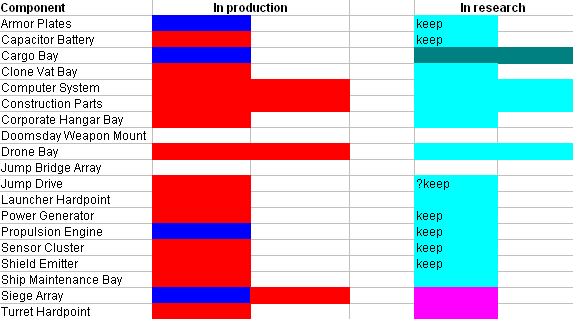
I didn't actually have the cash to buy a complete set of replacement prints, so I did it peacemeal. This is the status (as of a few days ago) of my components. It's probably pretty difficult to read if you didn't make it, but one cell equals one blueprint.

'Keep' means I'll be keeping both blueprints in order to increase production, rather than selling the one currently in production once it has been switched with a researched copy, and then itself researched to 100/20. This is because in the medium term I'm looking at increasing production to maybe 5 characters, which means I need moar blueprints.

I'd also like properly researched ship blueprints, eventually. This is a much longer term project project, and except for a few dread blueprints I haven't really gotten started on it yet. I expect I'll have all the replacement ship blueprints I need inside of 5 months, by which time sale of spare component blueprints will have freed up plenty of liquidity.

Also of note, I've decided to tear up freigher production permanently. Even when one of them (charon, of course) is pulling much larger profits than normal, the margins are still pathetic compared to jump capable ships. Plus, this is a good time to sell freighter prints -- my charon BPO went for 72% over NPC price.

Tuesday, March 6, 2012

Industry has low margins and is a bad career


We have a brand new first place entry for largest profit on a single ship. The carrier from a few weeks back still holds first for widest margin, but the 900 million I made on this hull beats out both that and the phoenix I made 700 million on after the patch in terms of net profit.

Friday, February 24, 2012

Reduced session change timers are super awesome

Because they let me move stuff faster.

My long-time reader will recall that I move minerals to lowsec by autopiloting them to an adjacent hisec system, then bouncing back and forth with a jump freighter. Jump in, drop off mins, warp to highsec, get more.

Previously I had been able to move two JF loads (73.6 million units) per 10 minute cyno activation. The cyno ended about 30 seconds too early to get in a third load.

Session timers affect this process process as following:

-Light cyno.
-Jump in. Wait for session change timer. Dock.
-Undock. Wait for session change timer (because hotdrops). Warp.
-Dock in highsec. Undock. Wait for session timer. Jump.
-Jump in the second time. Wait for session change timer. Dock.
-Undock. Wait for session change timer. Warp.
-Dock in highsec.
-Cyno runs out.
That's 5 session change timers I have to sit through, so when the session change timer is reduced I save 5 times the reduction per cyno gen cycle.

After the timer was reduced to 20 seconds, the cyno ended much closer to the time I was ready to jump in a third time -- so close that the JF had to wait for the cyno cooldown to finish so I could relight it. Eventually, by staying on top of things and docking/warping/jumping the second the session change timer finished, I was able to get in three jumps (110.4 million units) per cyno activation, with a few seconds to spare. This means the rate at which I could move minerals to lowsec increased by 50%.

The recent decrease didn't change much, but does give me a comfortable buffer, as shown at left.

If you figure 5 cynos per hour, allowing a few minutes for the JF to get back to highsec after the third jump, I can now move 550 million units of minerals per hour. The average load I move is about 500 million, and I need to move a load about once a week.

So, an hour a week. This is not a huge drain on my time, which is why I haven't bothered seriously looking into mineral compression.