Thursday, August 30, 2012
August financial report
A few things to note this month.
First, as pointed out by eve industrialist, I have been using the term "margin" incorrectly. Accordingly I have changed my old 'margin' column to 'profit %' and changed the elegant 'profit/outlay-1' metric to a filthy percentage. Better than being wrong, I guess.
Second, merging my main manufacturing process and abortive second one has allowed me to sell off a number of component blueprints. Unfortunately, the liquidity from this went straight back into minerals for the new ship blueprints that the process merge added to my production line and I continue to have basically zero liquidity.
Also, with mineral prices possibly dropping I have decided to sell off some naglfars that I have been holding and waiting for prices to rise. Run 69 has finally finished, and 74 will too... if I can find a buyer. My naglfar blueprint has been in research for 2 ME levels since the last time building them was a good idea. At this rate I'll have it in PE research before they're worth building again.
Oh, and taxes are starting to sting a bit. It might be time to work on that a little.
Server status widget
On the right sidebar you can find a new widget showing the status of my home server, and thus the availability of old screenshots and files.
Turns out making it was a simple matter of putting an image with the word "Up" on the server, then making a widget with that image and the alt text set to "Down".
Speaking of the server, I'm having loads of fun playing with virtualbox. I've gotten it to run invisibly in the background, and disabled the windowing system on the guest OS (ubuntu 12.04) so that it uses less memory. One of the nice things about linux is that it doesn't bloat over time like other operating systems tend to, and as you can see in the below screenshot it's running just fine on a whopping 64 MB of RAM.
Turns out making it was a simple matter of putting an image with the word "Up" on the server, then making a widget with that image and the alt text set to "Down".
Speaking of the server, I'm having loads of fun playing with virtualbox. I've gotten it to run invisibly in the background, and disabled the windowing system on the guest OS (ubuntu 12.04) so that it uses less memory. One of the nice things about linux is that it doesn't bloat over time like other operating systems tend to, and as you can see in the below screenshot it's running just fine on a whopping 64 MB of RAM.
Wednesday, August 29, 2012
Old screenshots are UP
A year or so ago my home server went down and all my screenshots from 2011-5-25 and earlier went offline. I wasn't playing much at the time, and didn't feel like fixing it.
On an extremely temporary and intermittent basis these are back online, being hosted via a virtual machine running on my work computer. My legions of screaming fans are encouraged to use this opportunity to review my lovely screenshots and pointed toward the screenshots tag. Also online are other files including old spreadsheets, source code files, teamspeak recordings, and old coalition maps.
At some point I may set up something more permanent, but this will probably last no more than a few days.
On an extremely temporary and intermittent basis these are back online, being hosted via a virtual machine running on my work computer. My legions of screaming fans are encouraged to use this opportunity to review my lovely screenshots and pointed toward the screenshots tag. Also online are other files including old spreadsheets, source code files, teamspeak recordings, and old coalition maps.
At some point I may set up something more permanent, but this will probably last no more than a few days.
Tuesday, August 28, 2012
Capital manufacturing update
Minerals aren't falling as quickly as I had feared, so I'm back to buying mins to build with.
All my replacement and new component blueprints have finished researching and are in production.
All my ship blueprints have finished researching and are in production, except that:
-I decided to skip the third archon blueprint I was planning on getting.
-My phoenix and naglfar blueprints are not in production because the margins on them are low.
-I decided to add a fourth rorqual blueprint.
-And maybe a second revelation blueprint.
All my replacement and new component blueprints have finished researching and are in production.
All my ship blueprints have finished researching and are in production, except that:
-I decided to skip the third archon blueprint I was planning on getting.
-My phoenix and naglfar blueprints are not in production because the margins on them are low.
-I decided to add a fourth rorqual blueprint.
-And maybe a second revelation blueprint.
I finally got around to creating my fifth building character. I have been blagging under the name "parasoja" since 2009-ish and only now have a character with that name.
In previous posts I have talked about increasing the number of ships per run, which will lead to me moving more minerals less often and reduce some spreadsheet overhead. I have been doing 4 ships per run, and was thinking of changing that to 6 or 8. Then I tried a run of 6 and noticed something:
When building 6 ships, you need more than 80 of many components. 80 is the "correct" number of components at which to split a run between two blueprints, because 80 (actually 89, so there's some leeway) components takes the same amount of time to manufacture as a carrier or dreadnaught hull. So if you install runs in a timely manner and split batches of more than 80 between blueprints, things will run smoothly.
Now, when installing 6 ships you need more than 80 of nearly all components. This is obnoxious because of the way I format split runs, and because most of them were barely more than 80, like 90-some.
I decided to resolve this by further decreasing granularity to 10 ships per run and changing the split run formatting to a multiple-column arrangement, so each one color-coded cell equals 80 components (except for the rightmost cell). This means that I will have far fewer runs in production at a time, each run will take up more space on my spreadsheet, and I will move much larger amounts of minerals at a time.
In previous posts I have talked about increasing the number of ships per run, which will lead to me moving more minerals less often and reduce some spreadsheet overhead. I have been doing 4 ships per run, and was thinking of changing that to 6 or 8. Then I tried a run of 6 and noticed something:
When building 6 ships, you need more than 80 of many components. 80 is the "correct" number of components at which to split a run between two blueprints, because 80 (actually 89, so there's some leeway) components takes the same amount of time to manufacture as a carrier or dreadnaught hull. So if you install runs in a timely manner and split batches of more than 80 between blueprints, things will run smoothly.
Now, when installing 6 ships you need more than 80 of nearly all components. This is obnoxious because of the way I format split runs, and because most of them were barely more than 80, like 90-some.
I decided to resolve this by further decreasing granularity to 10 ships per run and changing the split run formatting to a multiple-column arrangement, so each one color-coded cell equals 80 components (except for the rightmost cell). This means that I will have far fewer runs in production at a time, each run will take up more space on my spreadsheet, and I will move much larger amounts of minerals at a time.
The first 10-ship run was mostly carriers, and the minerals ran 12.8 billion isk.
Sunday, August 19, 2012
Capital blueprint research income, part 5: Copying component blueprints
Seeing this post first? Start at part 1.
Index:
1: Overview
2: Researching hull blueprints
3: Copying hull blueprints
4: Researching component blueprints
5: Copying component blueprints (you are here)
What is it:
If you own a researched capital component blueprint, you can copy it and sell the copies. However, due to the high volume of copies created you would spend what I consider an unacceptable amount of time dicking about with contracts. I would not consider this a highly passive income method, and only include it here out of a desire to be thorough.
EDIT 2012-8-21: Blake from k162space confirms this in comments.
Method:
The lowest priced non-outlier copy in jita is selected for the copy sell price, and 10 copies per month (actually 27.6-ish days, but I'm not going to bother to be precise here) is used to calculate monthly profit and monthly ROI.
Raw numbers:
Interpretation:
High effort, low ROI.
In practice:
Copy blueprint (10 copies, 5 runs per copy). Sell copies in jita.
EDIT 2012-8-21: Another idea is to assemble your component BPC into packs along with a capital ship blueprint, such that the buyer receives all the BPC required to make a capital ship. Examining this, I found that a rorqual BPC pack sells for 540 million, while buying the same blueprints off contracts only costs 411 million.
After some spreadsheet-fu, and assuming that the BPC pack in question is something which will actually sell, and pretending that the rorqual BPC was the same price as I could find one at the same material level on contracts, I found that this represents an 80% markup for the component BPC. This is almost significant, but it turns out that it only comes to an average monthly ROI on the component blueprints used to 5.5% -- still below the low end of what you can make doing something else which involves much less effort.
Conclusion:
Ha ha ha.
No.
This is the end of this post series.
Capital blueprint research income, part 4: Researching component blueprints
Index:
1: Overview
2: Researching hull blueprints
3: Copying hull blueprints
4: Researching component blueprints (you are here)
5: Copying component blueprints
What is it:
You can buy a capital ship component blueprint from an NPC seller, research it, and sell it on contracts for more money.
Method:
We look for the lowest priced, reasonably researched (minimum 100/10 ME/PE) blueprint on contracts, and use that and research time for 100/20 ME/PE to find monthly profit and monthly ROI.
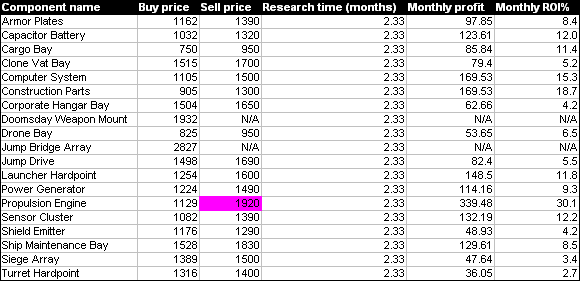
Raw numbers:
- Note: Research time is for 100/20 ME/PE because that's what I, as a capital builder, would want to buy.
- Note: Although far too high to stay where it is, the current sell price for the propulsion engine is for real -- I sold one for 2000 just a few weeks ago.
Interpretation:
To someone who actually builds capital ships, there is a pattern here: Components which are only used to build one type of ship (e.g. clone vat bay, siege array) have very low ROI, while ones which are used in most or all ship types tend to have higher returns. I present you with a table of components, where they can be found, how much they cost, and which ships they are used for.

In practice:
Buy blueprints from the NPC systems listed in the table, research them (I do recommend 100/20, but you can probably get away with 100/10), and sell them. Do NOT buy components in jita which are listed in a different system. Those aren't NPC sell orders.
Verdict:
Pretty solid numbers here. As someone who has actually done this I tend to suspect that overall you will have a better time researching component blueprints than ship blueprints, but I do intend to test this.
Next, part 5: Copying component blueprints.
Capital blueprint research income, part 3: Copying hull blueprints
Index:
1: Overview
2: Researching hull blueprints
3: Copying hull blueprints (you are here)
4: Researching component blueprints
5: Copying component blueprints
What is it:
If you have a researched capital ship hull blueprint, you can copy it and sell the copy.
Method:
We use the price of the cheapest reasonably researched blueprint copy available in jita, and the time to copy, to find monthly profit and monthly ROI.
Raw numbers:
Interpreation:
Only the orca, at 6% monthly ROI, even reaches the acceptable range; and with the recent mining changes orca BPC are probably for selling substantially more than we can expect them to in the long run. The rest of the numbers look pretty accurate based on my experience.
In practice:
If you wanted to do this, you would take a researched ship blueprint, make copies, and sell them. I disrecommend buying researched blueprints off contracts for this purpose, as it would take much longer to make up the difference than it would to research them yourself.
Verdict:
No.
Next, part 4: Researching component blueprints.
Subscribe to:
Posts (Atom)